Send us your mail or next updates.

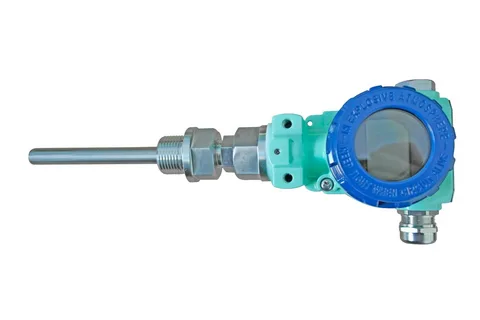
Industrial Temperature Transmitter for SCADA Water Treatment

Industrial Temperature Transmitter for SCADA Water Treatment

Product Overview

The Industrial Temperature Transmitter is a critical field instrument used in SCADA-controlled water and wastewater treatment systems to monitor process temperatures accurately and reliably. Temperature measurement is essential in many stages of water treatment — including raw water pre-treatment, disinfection processes, chemical dosing control, membrane performance monitoring, and heat exchanger performance — because temperature influences reaction rates, disinfection efficacy, solubility of gases, and overall process efficiency. Temperature transmitters convert signals from temperature sensors (such as RTD or thermocouples) into standardized analog or digital outputs that can be integrated directly into PLCs (Programmable Logic Controllers), RTUs (Remote Terminal Units), and SCADA host systems for real-time visualization, trending, control logic, and alarms.

Product Overview

Most industrial temperature transmitters are designed to work with standard resistance thermometers (RTDs) or thermocouple sensors, providing a 4–20 mA analog output (often with HART, Modbus, or PROFIBUS digital communication) that can be easily connected to SCADA hardware and software. These transmitters provide linearized temperature signals, enabling precise and stable monitoring across a wide range of temperatures — from sub-zero conditions up to several hundred degrees Celsius, depending on the design. They support universal sensor inputs, making them flexible for various measurement tasks (e.g., water temperature, chemical tank temperatures, or environmental monitoring)

In a typical water treatment plant, temperature transmitters are installed at critical process points such as raw water intakes, post-clarification points, chemical reactors, and discharge channels. For example, monitoring temperature at a disinfection contact basin helps operators assess chlorine or ozone reaction kinetics in real time; if temperature deviates from expected levels, SCADA logic can trigger alarms or adjust flow rates to maintain effective treatment. Similarly, temperature information from membrane systems (like ultrafiltration or reverse osmosis) assists in optimizing clean-in-place (CIP) cycles and reducing fouling. Real-time temperature data streamed to SCADA dashboards allow operators to see current conditions, historical trends, and automatic alarm notifications when preset thresholds are exceeded.

iTEMP TMT72 Industrial Temperature Transmitter Datasheet (PDF) https://bdih-download.endress.com/file/005056A5E3831EEF92E6FEF29BE6B972/TI01392TEN_0624-00.pdf