Product Overview
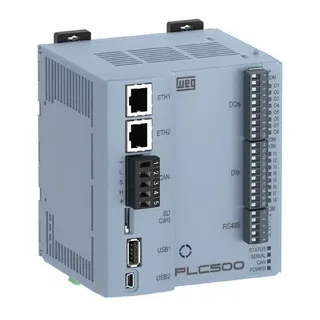
PLCs continuously collect data from field instrumentation, including flowmeters, level sensors, pressure transmitters, temperature probes, and water quality analyzers. Based on preprogrammed control logic, the PLC processes these inputs and generates output signals to control equipment such as electric valves, VFD-driven pumps, blowers, and chemical dosing systems. The PLC exchanges data with the SCADA system via industrial communication protocols like Modbus TCP/RTU, PROFINET, PROFIBUS, Ethernet/IP, or OPC, enabling real-time monitoring, alarm management, data logging, and operator control through HMIs.
In water and wastewater treatment facilities, PLCs are widely used in raw water intake stations, filtration units, clarification systems, disinfection processes, pumping stations, sludge handling systems, and distribution networks. For example, a PLC can automatically manage filter backwash sequences based on differential pressure signals, regulate pump speeds according to flow demand, or interlock chemical dosing with flow and water quality measurements. This automation improves process consistency, reduces manual intervention, and enhances overall plant efficiency.
Siemens SIMATIC S7-1200 System Manual (PDF) https://cache.industry.siemens.com/dl/files/593/109741593/att_895681/v1/s71200_system_manual_en-US_en-US.pdf