Product Overview
In a SCADA context, the PLC acts as an edge control device, bridging the physical process and the SCADA software. It collects real-time signals from devices such as level sensors, flow transmitters, pH probes, pressure gauges, and turbidity sensors. These data points are analyzed against pre-defined logic rules to make immediate control decisions — for example, starting a pump when a raw water tank reaches a low level, opening chemical dosing valves based on measured pH levels, or adjusting blower speeds in aeration tanks. Such logic ensures consistent treatment performance, optimal energy and chemical usage, and regulatory compliance.
Unlike general-purpose computers or PLCs of earlier decades, technology advancements now allow PLCs to feature high-speed processing, built-in redundancy, network communication, and robust diagnostic capabilities. PLC systems are often paired with Human-Machine Interfaces (HMIs) for local monitoring and control, and they report data to SCADA visualization software via industrial communication protocols such as Modbus, Ethernet/IP, Profibus, Profinet, and OPC UA. This integration allows operators to view trends, historical logs, alarms, and perform remote adjustments from control centers or even via secure web/mobile dashboards.
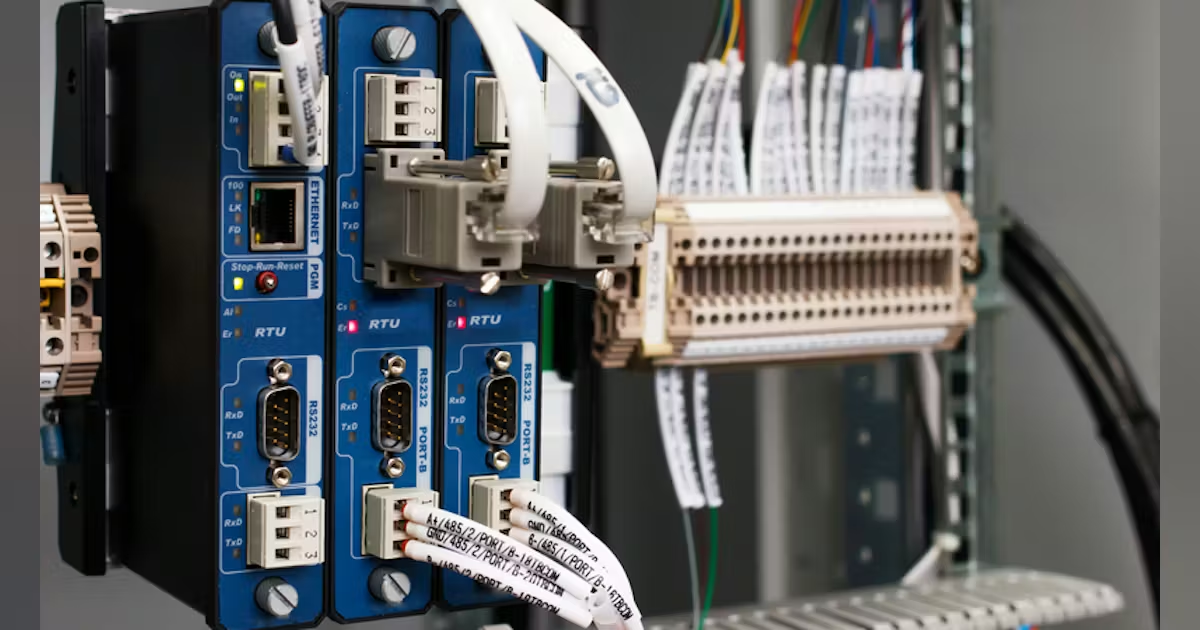
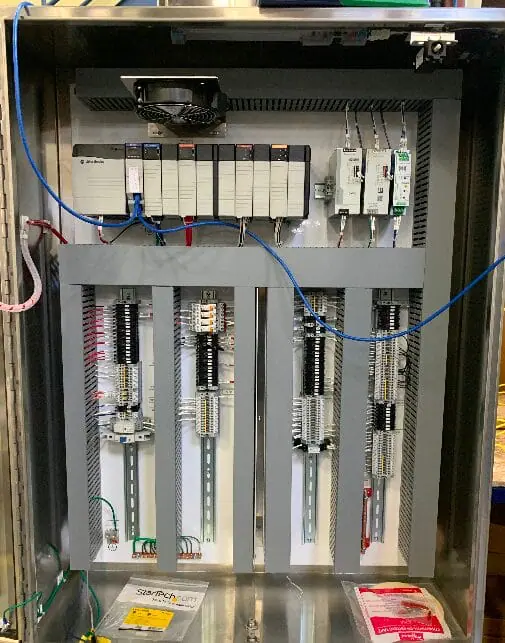
PLC hardware typically consists of a central CPU module, power supply, input/output (I/O) modules, communication modules, and sometimes expansion racks for additional I/O points. The input modules receive digital and analog signals from field devices, while output modules send control commands to actuators. The CPU executes a control program written in ladder logic, structured text, or function block diagrams. This program defines how the PLC reacts to inputs and what control action it takes, which can range from simple on/off commands to complex PID loops for flow, level, or pressure control.
Because water treatment plants are mission-critical infrastructure, reliability and uptime are key. Many PLC installations include redundant CPUs, backup power supplies (UPS), and diagnostic routines to ensure continuous operation even during electrical disturbances or partial hardware failure. PLC cabinets are usually mounted inside control room panels with clear labeling and structured wiring for easy maintenance, and they often integrate seamlessly with variable frequency drives (VFDs), motor starters, and other control equipment.
Whether handling pumping stations, filtration processes, chemical dosing, clarifiers, membrane systems, or sludge dewatering, PLCs form the heart of industrial automation — providing precise, reliable, and programmable control that keeps water treatment processes running efficiently and safely.